“Azar sat on the corrugated iron floor of a van, huddled against the wall. The undulating street made the car sway from side to side, swinging her this way and that. With her free hand, she clasped on to something that felt like a railing. The other hand lay on her hard, bulging belly, which contracted and strained, making her breathing choppy, irregular. A heat wave of pain spouted from somewhere in her backbone and burst through her body. Azar gasped, seizing the chador wrapped around her, gripping so hard that her knuckles turned white. With every turn, she was thrashed against the walls. With every bump and pothole, her body was sent flying toward the ceiling, the child in her belly rigid, cringing. The blindfold over her eyes was damp with sweat.”
Amazon
 /Amazon.co.uk
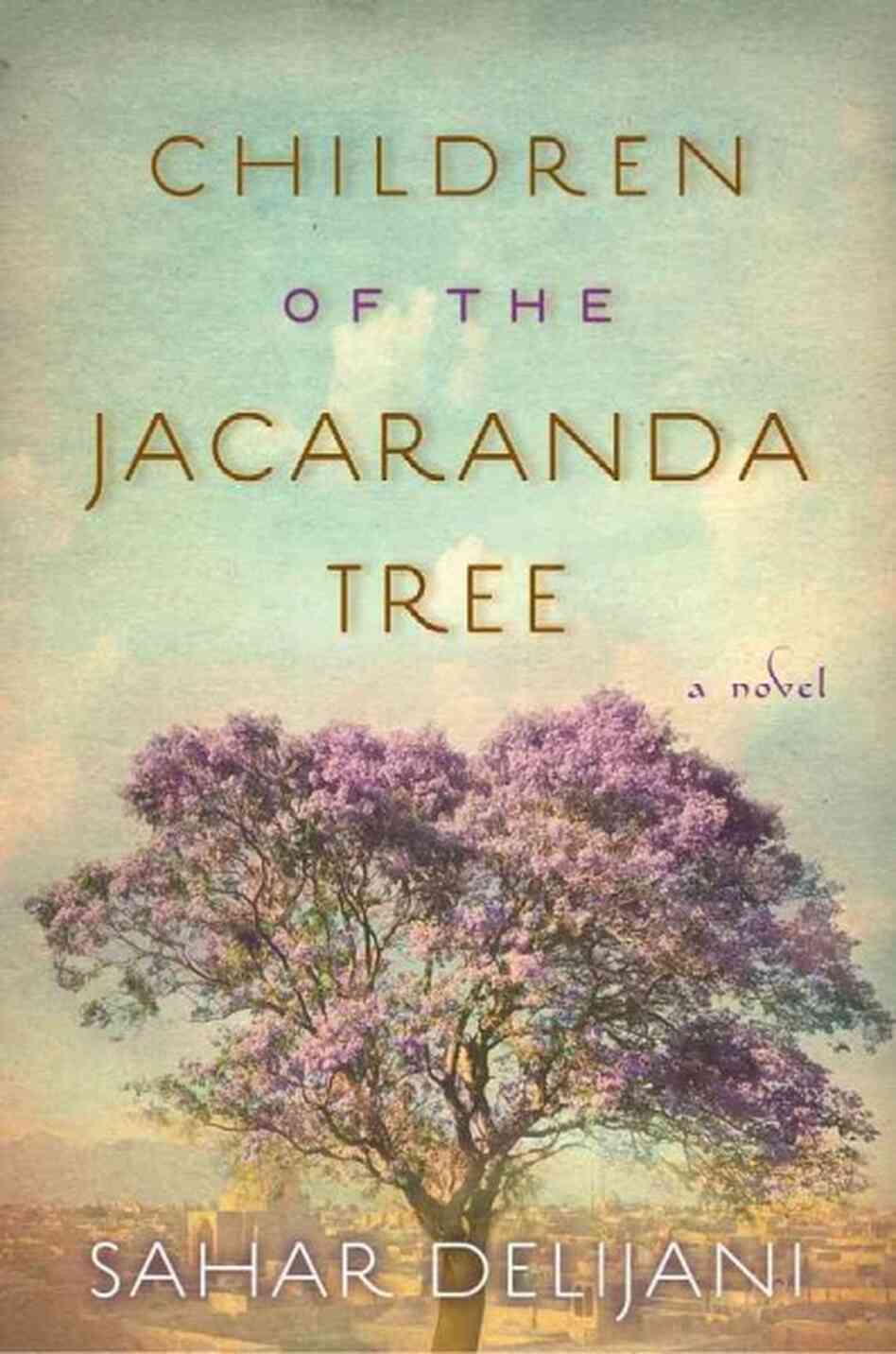
Children of the Jacaranda Tree by Sahar Delihani is a book that focuses on the Iranian Revolution- more specifically the years between 1983 and 2011, and the fall of the Shah, as well as the chaos that followed.
PLOT/ REVIEW
Children of the Jacaranda Tree is less of a plot based book and more a collection of intertwining, related stories. They all share the same general plot and are all part of the overall story, but the way the book is set up makes them seem more individual and personal, though this book is not a collection of short stories- as may have been implied.
Each chapter begins or continues a person or group of people’s stories. So every time a new chapter begins, a new story or a continued story is told. Within each chapter the POV switches constantly too, but it’s done pretty seamlessly (for the most part), so that it never becomes distracting or confusing. Throughout the book we hear the stories of Azar (who is a heavily pregnant woman being held in Evin Prison in Tehran, and is going into labour), Leila and Maman Zinat (a daughter and mother (respectively), looking after their relations’ children while they do their time in prison. Throughout the years, the children include Omid, Sara, Forugh, Dante, and many others who need help. All young children waiting for their parents to return- some of whom have never known their mother or father. The focus of the story varies depending on the chapter, but each character gets their own arc. Another chapter focuses on Amir- in Komiteh Moshtarak Detention Centre, Evin Prison in Tehran. He has been imprisoned for 45 days and is constantly blindfolded. His wife, Maryam, was pregnant when he was arrested. The story also follows from Maryam’s POV- ranging from the year Amir was taken (1983) to her current life in 2009. Another focuses on Donya- whose mother was imprisoned long ago, finally released and then emigrated with her daughter to America- where Donya’s been for the past 15 years. The final chapter (and alternate POV) is Neda’s story (or part of it), and is the story most similar to the author’s own (at least partly). Both were born in Tehran’s Evin Prison in 1983.
However, the author was raised by her mother in California. Her father was imprisoned for at least seven years after she was born. She and her husband now live in Turin, Italy- another important place in this book. In fact, the entire story takes place in either Tehran or Turin.
Azar’s story is perhaps the shortest, but also the first- so one of the most impactful. Her story sets the tone for the rest of the book. When we find her she has been prison for a few months, after she and her husband, Ismael, were arrested for being political activists- protesting against the regime in 1983. Iran has been at war with Iraq for three years, and Saddam was Iraq’s leader at the time.
Her story tells of her experience with labour, childbirth and having a baby in prison. Her child brings new hope to her and the women who share her cell. Azar has no idea what is going on outside her tiny cell, or what happened to her husband, but for now she has a little piece of both of them in her hands.
In her cell there are many other women- including Parisa (who is also pregnant and has a son waiting for her outside the prison)- Omid.
Time skips are frequent in this book, and each chapter can go either forward or backward between any year from 1983 to 2011, though usually in substantial increments. The story spans three generations of people, who are all interconnected in one way or another, sometimes in multiple ways. The chapters alternate between years and characters- with the same time period retold multiple times from different POVs. Between 1988 there is a sudden time skip to 2008, and the next generation of characters, which mostly fills in some gaps left from the previous generation’s characters, and also sets up the generation to follow.
There are a few motifs played through the book. The jacaranda tree is an obvious one, but other motifs include butterflies and pregnancy (obviously symbolic of new life while the old is taken and/or abused). Another strong theme of this book is the power of memories. That decades can pass, but the memories can still feel fresh in the mind- still have the strength to cripple you or lift you.
This book is more a story of relationships, which can make for a slow-paced book as there is little plot. It is more a story about how much a person can impact another’s life. How relationships are born through necessity or by chance, and how they last or change- regardless of whether the person is with you any longer.
In its own words, this quote from the book perfectly describes what the story consists of and is about:
“the mysterious ripples of love and pain, of breaking and blossoming, of past and future.”
There are always two sides to everything. There cannot be love without hate, or a future without a past. There are many different kinds of relationship and this book explores a lot of them. What must it be like, to be a child who is more comfortable with other women than your own mother- for her to be a stranger to you. Childrens’ relationships to one another, and how they change as they age, along with whether they grow up together or not are explored frequently in this book, along with the relationship to the women who raised them compared to those who birthed them.
A LITTLE BACKGROUND
The war and regime are more of a necessary plot point to place the characters in the needed conditions, as well as to immerse the reader in the truth of events. These characters and situations may be fictional, but they most likely happened. There were thousands of people killed or hurt during their protests of the regime- the regime that was meant to free them all from the the fallen Shah. In 1988, 4000-5000 young men and women were executed in the months of July and August. The committee interviewed all political prisoners and ordered executions of those deemed “unrepentant.” Twenty years later, and the next generation is still suffering the country’s rule, but in different ways, and the opposing side are more open- killing on the streets instead of behind the walls of a prison.
During the chaos surrounding the demonstrations and loss of the country’s leader, Iraqi leader Saddam Hussein decided to take advantage of the disruption that followed the wake of the Revolution by invading territories previously taken by Iraq during the Shah’s rule. In 1980, Iraq invaded Iran, starting the Iran-Iraq War, which the Iranian Regime used as an excuse to execute many of it’s own people. By 1982, the Iranian forces had managed to drive out the Iraqi army. In 1987, Iran tried to close the Persian Gulf- thereby stopping oil flow to Iraq, after almost seven years at war with the country. In 1988, Khomeini accepted a truce created by the UN, and the war ended. Iranian casualties were estimated to be between 500,000 and 1,000,000. Following the war, President Rafsanjani concentrated on keeping to the ideology of the regime, while trying to rebuild the country. He served until 1997, when Khatami took over. Khatami is not generally thought to have been successful in freeing his country. In 2005, presidential elections brought Ahmadinejad to power. He was again voted in 2009, winning over Mousavi- though there were conspiracy theories that provoked the 2009-2010 Iranian election protests in (not just Iran), but many major capitals in the West too.
Out of all the different stories told, I think Amir’s is my favourite. It is easily the darkest, and most chilling, but it’s also very endearing in terms of Amir himself- which is why it affected me the most. I cared for all the characters, but his story resonated most with me for being short, but effective.
All the stories are dark (as can be expected), but quite how much varies on the story. Some are simply tinted with dark memories or fears, while others are seeped in it- the inescapable fate.
This is a book that ends on a slightly hopeful note, that describes the power of memories, relationships and cleansing- revealing everything to the people that matter, that need to know, rather than keeping it inside and letting it fester- to slowly eat away at you.
A well-rounded story, filled with as much love and comfort, as it is hate, fear and hurt. With as much joy and new life, as pain and loss. It’s not necessarily a powerful story- despite it’s subject material- but it is a real one. It is based on fact and spreading the word goes a long way to helping end the issues. I wasn’t as deeply moved by the story as I thought I would be, but I did enjoy the book. It may be that the switching chapters/POVs makes it hard to not distance yourself when the book already does that. Some of the characters are mentioned in others’ stories, but then it feels distanced, rather than if we followed one or a couple people’s stories, but were with them for longer. There are so many characters in this book that, it’s not so much that it doesn’t work (as all their stories are interesting), but that the emotion is filtered too much. With so many people to care about, feeling so many different things at one time (thanks to the time skips), the characters go from extreme loss to falling in love, to the happiness of a well loved child, to rekindled relationships in a short time span. It’s a little like an emotional rollercoaster- with so many ups and downs going by so quickly that you don’t really have time to immerse yourself completely in any of them.
However, I did like this book. I wouldn’t go as far as to say I loved it, but I would read it again, and I would recommend it, so clearly there is enough to be gotten out of it (in my opinion) to take the time to read it.
Disclaimer: I received this book through a giveaway. This is not a sponsored review. All opinions are 100% my own.


