First Paragraph:
""Perverse" was Emylene Stipe's signature response to just about everything. Others her age were more apt to say "cool" or "wicked" or "awesome", but you knew Emylene was in the house when you heard, "Loved that band last night- so perverse", or "She's hanging with that dude? Perverse!" Or, "I hate people who eat with their mouths open, they're so perverse."
Amazon / Amazon.co.uk

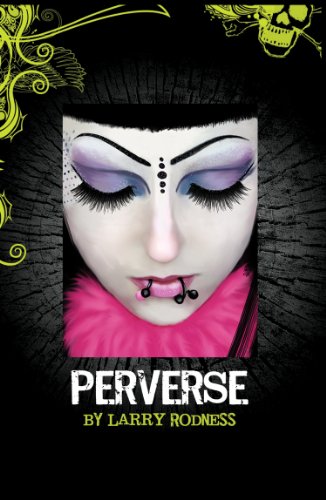
Perverse is a supernatural tale by Larry Rodness.
PLOT
Emylene Stipe is a Toronto-living, nineteen year-old goth, who is known as the 'goth princess' to her friends due to her parents high status. They fight for all rights goth, and proudly lead the dark wave. But Emylene's problem is wondering how to 'rebel against a family of rebels'. She's reached those argumentative you-don't-understand-me years, and she's itching to take on the authority figures that are her parents.
As with many teens she butts heads with them a lot, and everyone is at the end of their tether. Eventually Emylene moves out- giving everyone some well needed breathing room. Living only a dozen blocks away gives her independence, with security.
Her newest passion is Stelio- a forty year-old Greek who speaks right to Emylene's heart, starting with the first black rose he leaves hanging on her doorknob. When the two are wandering down the street one day, Emylene notices Stelio tense when he lays eyes on a charcoal sketch in an old antique shop. He makes nothing of it, but of course Emylene has to have it.
She hangs the barren, snowy landscape on her bare, bleak wall, entranced by the solitary cypress tree in its centre. But the sketch has secrets, ones little Emylene will soon discover, starting with footprints in the drawn snow, and the beautiful young girl who left them.
REVIEW
I went into this book knowing very little about it. I tend to be of the mind frame that the less you know, the better. Anyway, this meant I was not aware this was a 'vampire book', but I found it a refreshingly bearable use of the urban legends. Yes ladies and gentlemen, what we have here is a story about (or maybe 'including' is better?) vampires- known here as Vrykolakas. This may be a mild spoiler as we're not given this information until about a third of the way through the book, but it's a little hard to talk about the book without mentioning them.
I want to say this first, vampires have had a very bad rap since becoming a trend some years ago. More specifically, since they shifted from blood-thirsty creatures of terror to romanticised, teenage fantasy boy hunks. The progression is not necessarily a bad thing in itself (if done well- which unfortunately was not often the case), but the over saturation definitely was. Soon most everyone was sick of the fanged denizens of the night.
These vampires, while they may not be 'traditional', at least have the concept of one. Of creatures who seduce their prey, while malevolence burns in their eyes. While they never reach 'horror vampire' status, they are at least a far cry from 'romantic, sparkly' vampires too. Personally, I find terrifying vampires who want to rip my throat out, far more interesting than teen idol vamps. We have enough teeny-boppers sucking the life out of us already- without having to read about them in what was once a majestic and revered genre. I for one am glad to be getting back to it.
Now, first and foremost this may appear to be a story of the supernatural, but a lot of emphasis and time is placed on prejudices. The age-old fact that many people fear those who are different, or things they don't understand. A lot of the story focuses on Emylene's feeling of being an outcast (as many teens do), but on a more extreme level using her 'goth-ness' as a metaphor for many other forms of bigotry.
There is also some exploration of social and political issues, as well as satire on desire and obsession- if a little exaggerated. The lies we tell to convince ourselves and those around us that one more 'hit' won't hurt. It looks at the very nature of addiction. There is no black and white, no clear answer. Social stigma has been around since the dawn of humanity, and addiction was not far behind. Everyone has one- usually more. Some less harmful than others, but all as all-consuming as each other. The book also briefly touches on why we seem to need addictions. Are we so unhappy in our daily lives that we have to create an escape or false happiness through objects or actions?
It becomes a force of habit, a placebo, Pavlov's dog. It makes us feel good, because we associate it with emotions from previous times. Whether or not that is real happiness is up for debate, but suffice to say that as a species we can never be addiction free. But (depending on the form of the addiction) maybe that's not a bad thing. We all have cravings, and to ignore all of them would be unhealthy. So the question becomes not so much about kicking the addiction, but in choosing the ones that are the least harmful, and of moderation. Anything can be addictive- sex, drugs, coffee, exercise, reading, etc. As a species we are naturally inclined to overindulgence, making us susceptible to addiction. This book goes a little into the 'darker' addictions, and exactly how far we are willing to go, and how much we will tolerate to satisfy the cravings. The vampires act as a 'channel' for addiction, prejudice, etc, etc, discussing the very real topics, while making them more ambiguous and universal through non-existent beings.
Anyway, this book seems 'act-driven'. It's almost like three different stories blended together. Each interconnected, but separate. It's not so much that the POV switches (though occasionally it does), but more of the focus shifting. You start with Emylene's, then the focus switches to another character, and finally another (I won't say who because they could be considered spoilers). Each time a new story is introduced, we get taken further back into the past- through the different generations and circumstances that brought them together. The main focus is still on Emylene, but when the other two get their turns, she becomes more of a secondary character.
The end was a little too easy in my opinion. It came together just a little too neatly. You spend some two hundred or so pages getting to that point, and it's all over in just a few. Though the last line adds a final element of mystery, and possibly a hint at a sequel (though I like the open ending as is).
On a brief side note, I felt the antique shop owner who sold the sketch to Emylene in the first place, was a little stupid considering that he knew exactly what it held within its image. How hard would it have been to say, "It's not for sale"? But then I suppose we wouldn't have a story.
OVERALL
I breezed through the smooth-flowing writing quickly, and the only times I felt any kind of 'road block' was when the story meandered slightly when the story switches its focus character.
As I said earlier, I am very glad to see violent, demonic vampires again. This is the first 'vampire book' in a long time that I have enjoyed at all- let alone actually liked.
Disclaimer: I received this book from the author. This is not a sponsored review. All opinions are 100% my own.
Seven Different Kinds of Smoke is a collection of short stories by Roman St. James.
Seven stories to be exact. They all focus on some kind of hardship or harmful element.
The first is 'The Greenest Grass', and tells the story of Tasha Evans- who is a transgender man born into a woman's body.
First Sentence:
"Tasha Evans stared at her face in the mirror and wondered what it would be like to no longer exist."
He always knew he was interested in women, but considered himself gay for the longest time, having never made the connection between wondering what it would be like to be a man and actually being one.
Growing up in Mississippi, this alone would cause friction between him and a lot of the residents, but adding to that his African-American race and there's a lot of bigotry thrown in his face. Through the story we get a view of his past and a glimpse of things to come. He has a plan, but how much is he willing to sacrifice to make it happen? This is a story about identity.
The second is 'Seven Different Kinds of Smoke', the namesake for this book.
First Sentence:
"Kenya Watkins was nervous."
This story provides an explantation of the 'seven different kinds of smoke', though they're pretty interchangeable. The seven different kinds of smoke are just different (and more specific to the characters of this book) names for the seven deadly sins, mixed in with some life lessons to help deal with them. What's important to note, is that while 'smoking' harms the 'smoker', it also harms those around them. Other people's 'sins' can harm others, whether intentional or not.
Here we meet Kenya Watkins- a twenty-nine year old woman with an eventful past, of which several events have unfortunately been plastered over the news. She's sitting in a cafe contemplating the bottle of pills in her pocket, when an old woman joins her, claiming she is one and the same person and is here to save Kenya from herself.
As with any sane person, Kenya 1 does not believe Kenya 2's story and so decides to test her with a series of questions, ones only she knows the answers to. If Kenya 2 can pass the test, she'll listen to anything the old woman has to say.
In 'Babble' Angela and Jack are a married couple with communication problems.
First Sentence:
"The woman, Angela, walked into her home and dropped her purse on the dining room table."
They're trying to get through them and listen to each other better and more and are a prime example of how one small misunderstanding can lead to serious repercussions.
Next up is 'Leap Frog', a story about Alexandra 'Alex', who believes she turns men into frogs with a kiss.
First Sentence:
"So do you want to play, or what?" Blue asked Alexandra."
She and her girlfriend are visiting Dr.Phillip Sanford, for help with their relationship. The problem it seems, stems from this belief. Alex isn't so sure she's gay, but she has sworn off men, after turning one too many of them into amphibians. Dr. Sanford has his work cut out for him.
'A Void of Sorts' is the story of Marie, a woman who has just lost her son.
First Sentence:
"One day you have a son."
A son she doted on a treasured, as all mothers do. She had always wanted a child, but had no partner of her own, so spent her savings in sperm banks. After that failed, she went 'bar hunting', looking for a suitable man (physical features wise), with the best genetics, that she could use to get her pregnant. After a few failed attempts, she finally managed it, and now her precious son is gone. Hell hath no fury like a mother.
The penultimate story is 'The Tell Tail Tale'.
First Sentence:
"Ding Dong."
We meet a grandfather babysitting his twin, seven-year-old grandsons and making up a bedtime story for them. He is a little upset with the man his son has become- or rather where his son's values lie, so the story he tells his young grandsons, is his son's. Not that they know that.
The last story is 'Elevation'.
First Sentence:
"Mrs. Alberta Terrell Henderson woke up and looked at her clock."
Mrs. Alberta Terrell Henderson has sold or given away all of her possessions. Her beloved husband died a year previously and she is 'going to meet him'. When her daughter shows up confused by the movers, Alberta finds herself with an extra person for the 'journey'. Her daughter, afraid of what her mother's ambiguous words mean, decides to follow her and make sure she doesn't do anything stupid.
Despite her probing questions, her mother remains vague, and keeps repeating the same phrase as an explanation, without much detail. All her daughter can do is tag along and try to keep her mother safe.
An interesting range of topics are explored in these seven stories. Some bittersweet, some humorous and some hateful. That's one of the good things about collections of short stories- there's usually something for everyone.
The stories can be about a lot of uncomfortable topics. For example hate crimes. Most of the stories centre around women. Every main character is black and a couple are gay. All three are hot topics that can draw a lot of bigotry. In some of them, it provides a very raw and real perspective and we get a good story out of it. But I found myself wondering if it was necessary for every story to centre around a particular race. I want to point out now that I have absolutely no problem with any race. I'm not against any skin colour, hair colour, religion, sexuality, gender, etc, what I'm interested in is the person.
So, would it have made any difference if some of the character's race was different? There are a few stories where race doesn't really play a part. Perhaps leaving some of the character's features deliberately vague might've been a better option. Rather than making this a book about seven stories of seven black people, I think it could reach a larger audience if it was simply seven stories about seven people. There's always the danger of putting yourself into a too specific niche.
And these stories are worth reading. They all have interesting things to say and their own points of view. I can see what the author was trying to achieve by making all the characters black, but I think a little more subtlety could make this an amazing book. Rather than simple saying 'this person is African-American', allow the description to convey the same thing. Through the culture and the environment. If this had been one story, the method used would've fine. But when each time you start a new story and immediately see 'this person is black' it can get a little tedious and repetitive. Instead, work it into the story. Something along the lines of 'so-and-so always faced prejudice because of the colour of their skin'. It gets across the same point without being quite so blunt about it. Allow the reader to make the connection themselves.
Other than that, I did enjoy these stories. If I had to pick a favourite it would be either 'The Greenest Grass'- which deeply explores the subject of a person's identity or 'Leap Frog' for the comedic (though slightly dark when I think about it) tones. If you're wondering whether to pick this up, as I said earlier, short stories almost always have something for everyone.
Disclaimer: I received this book from the author through a giveaway. This is not a sponsored review. All opinions are 100% my own.


 /
