Monday, July 1, 2013

To Put Your Grief Behind You, You Cannot Do Nothing. You Must Look Forward and Take the First Step


First Paragraph:

"The first time I lost my husband, we were in Italy on our honeymoon. For the briefest of moments, as he walked toward me with our train tickets tucked in the back pocket of his jeans, the sunlight swallowed him. Even though he came back into view not more than a second later, my breath caught. I had this terrifying thought that something could happen. That moments were fleeting, and with the snap of a finger, he could be gone."


Wishing on Willows by Katie Ganshert is a contemporary romance novel. A second book, that I suppose you could call a sequel. It follows the same cast, around the same town.


If you'd like you can check out my review of Wildflowers from Winter (her first book) on my blog here: 


http://needtoreadgottowatch.blogspot.com/2013/03/the-harsher-winter-more-wildflowers.html


There will be a few spoilers of that book in this review, as it is a sequel. So if you want to read the first book first, check out that review for details. Spoilers of the first book beyond this point.


Set four years after the first, we return to Peaks, Iowa. Whereas the first story was focused mainly on Bethany, this book focuses on Robin. 


Now fully running her cafe- Willow Tree Cafe- and looking after nearly four-year-old Caleb, Robin is doing a lot better and finally beginning to recover from Micah's death. Their dream was to open a cafe, and through it Robin feels a little less lost in her loneliness. Her interaction with the community helps too. She's a member of One Life- a ministry that helps out the needy in the community, and runs a grief support group in her cafe, for those who have experienced similar hardships.


There are the usual bills to pay, business to run, son to watch growing up, thankfully all provided for by her inheritance and Micah's life insurance. Which is well as the cafe isn't getting enough clientele to stay in the black alone. She is still a young, grieving widow and coming to terms with it in her own time. The loneliness that comes with it and the understanding and acceptance that are necessary to heal, but hard to let in.


Her sister-in-law and roommate, Amanda, (along with a couple members of her support group) think it's time she got back on the horse and started dating again. Not just for her own well-being, but for Caleb's. But Robin isn't interested. Micah's memory is still too raw. How could they expect her to just move on?


Meanwhile, a new software company is opening outside the town, and with it there is the chance of increased business and more tax revenue for the residents of Peaks. There's talk of condominiums going up, to provide housing for the new employees. 


Ian McKay is following in his father's footsteps. A man who came from nothing and built a successful company. They are looking to develop the condos going up in Peaks. For Ian, this is a chance to prove himself- to the company and his father. To prove he isn't a failure. They need this deal. Without it the company will have to downsize and cut jobs. 


So Ian heads off to Peaks, leaving behind his past for a fresh start, at least while he's visiting. The problem- the condos are set to go up in the neglected downtown area. Where Robin's cafe is located. The only way the site can be secured is if Robin sells- which of course she has no plan on doing. The battle divides the town. Those who want increased revenue want Robin to sell, but there are those loyal to her and One Life- which will have to move to a higher rent area, and so will have less to give to the needy.


Ian and Robin are at odds, their plans opposite and put at risk by the other. Both equally as determined not to cave. Their fist meeting isn't exactly electric, but the possibility of sparks is there. The conditions are met, one strike and they'll light. However, their different agendas will cause entirely different sparks to fly.


Meanwhile, Amanda is trying to put a bad break-up behind her. She thought she'd found the one, until he up and left for Africa indefinitely on missionary work. She would've fought, but what could she say to that?


This is predominately a story about letting go and moving forward. The plot follows the age-old formula known to this genre, but hey, it works. Like many other authors of this genre, she likes to create friction between her characters. There's always initial dislike, cautious trust, misunderstandings, etc. Anyone familiar with the genre knows the ending before they've read the first line. You know exactly how the story will play out in terms of basic outline. 


But the characters offer their own personality quirks, fazed onto the character models that are always present in this genre, though they do offer something new each time. No matter how similar characters may be, they are not the same and neither are their situations, which stops them getting dull and repetitive. 


The same goes for the plot. The basic outline for romance novels is the same, but everything else still needs to be filled in, coloured, brought to life. Like kids with a colouring book. They are given the same lines, but every finished picture will be different. So it goes with outlines for books too. 


If you read the first book, this one offers more of the same. Both books are easily stand-alone if you're only interested in one. You're understanding of one is not dependent on having read the other, though you will have a little more filled in, especially when it comes to Robin.


The same characters are present, with a few new additions. They each have a warmth to them, which does well at welcoming the reader into their lives. I would've liked to see more of Bethany and Evan's lives, as they were the ones who captured us in the first book. There are only brief snippets of their lives in this book, told from Robin's point of view. A little disappointing, but understandable.


Robin's story was originally part of the first book, but cut down for Bethany's. So this book was formed, using the remnants and a new plot with a few extra characters. 


As with the first book, while God and Christianity play a part in the story and are very important to the characters, they are not the main focus. This is not written as a religious text with characters added, but as an in-depth story that Christianity happens to be a part of. This is the right way to add religion into your books, without them sounding preachy and off-putting and still being enjoyable to non-religious people or people with different faiths. 


Like the first book, the story ends with a new beginning, leaving the readers wanting more, but content with what they have. This is a feel-good book that will relate to anyone who's ever had to make a difficult choice (ie everyone) or had to comes to terms with something painful. The author likes to explore 'letting go' and accepting. Finding happiness through dark clouds of pain. Bringing colour back into the washed out, depleted world that is caused by deep-rooted grief. 


I thoroughly recommend both this book and the previous one to any fans of contemporary romance. If you're not a fan of religion in your fiction, I can still bet you'll enjoy these books. 


Disclaimer: I received this book through Blogging for Books. This is not a sponsored review. All opinions are 100% my own. 

Friday, June 28, 2013

"All You Need is Love" and Maybe a Little Imagination


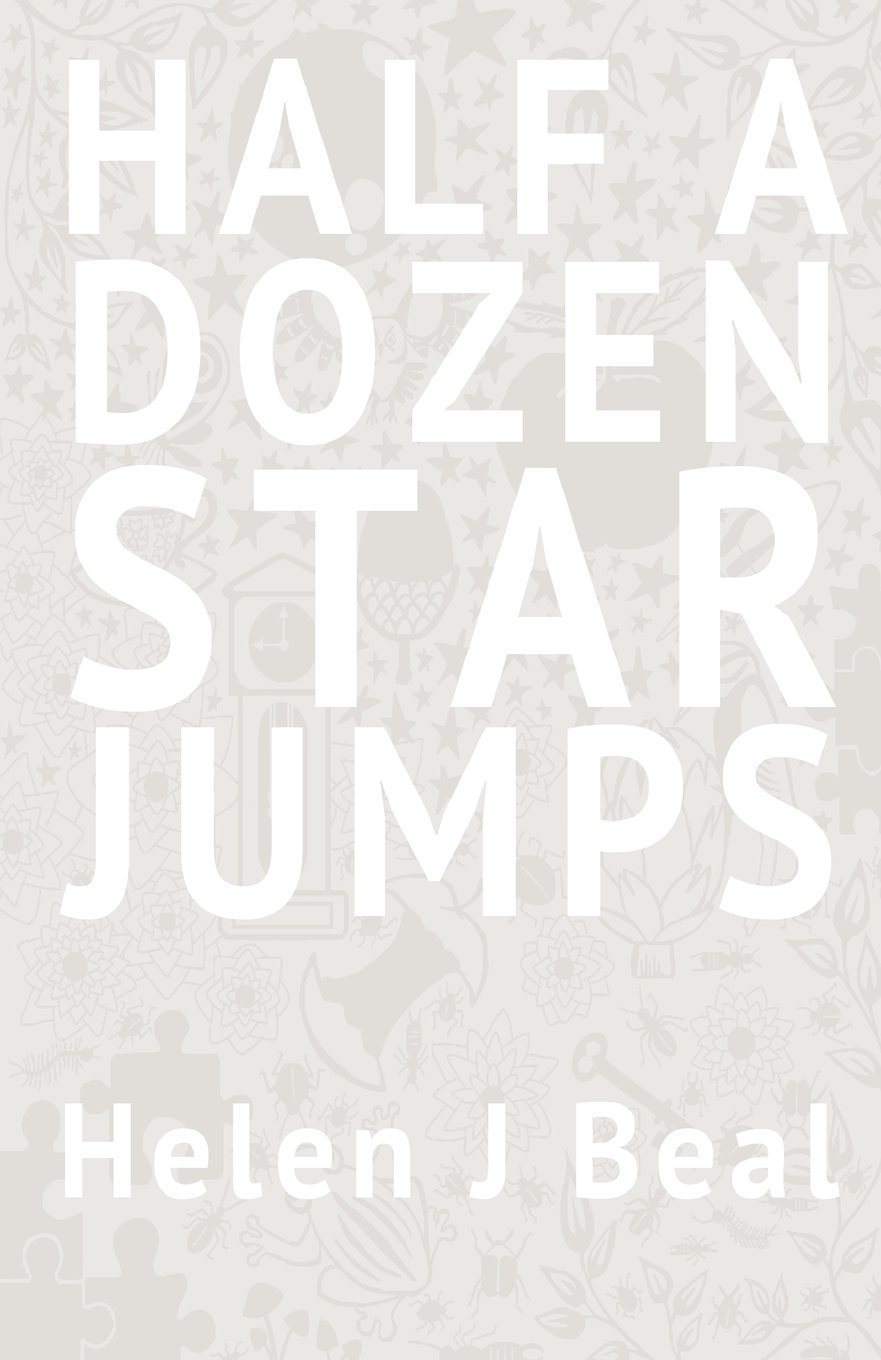
Half a Dozen Star Jumps by Helen J Beal is a collection of six short stories.


The first, "The Sculptor's Muse" is the story of an artist enchanted by a singer. Red, black and white play a motif through this short and sweet story. 


First Sentence: 

"I heard her first."

Inspiration comes in many forms and a muse can be a reciprocal thing.


In the second, "Blackberry and Apple Crumble", a young, married couple are hitting a few snags in their very new marriage. This causes a lot of tension. So when they discover that both their phones are missing, they are quick to blame each other. Can the Christmas spirit and some delicious treats bring back the spark?


First Sentence:

"Larry wandered down the stairs dressed in yesterday's underpants and a burred sweater Meg had bought him when he was in a fat phase."

This is a humorous little story that defines the saying, "You are what you eat."


Thirdly, there is "The Jigsaw Fairy". 


First Sentence:

"As he turned the key in the back door lock Dan thought about the last time he'd been here."

Dan ran away from home in the middle of the night three years ago when he was sixteen. His parents were overly critical and unsupportive, so he just packed up and left. One Christmas Eve, he left a jigsaw puzzle on their doorstop. Now he's breaking into the house to finish it for them. He's certainly planning on leaving his mark.

Next is "The Blight of Blossom". 


First Sentence:

"I am old now and it is dusk in the cherry orchard."

An old woman looks out over a cherry orchard and reminisces about how the human race fell, leaving a few survivors to rebuild on the moon. They live in a biodome where everything is controlled. She remembers what life was like before the end came, and what's come since. 

Loneliness has many forms.


In the penultimate story, "Flutter to a Fall" we meet eighteen-year-old Tilly and her friend, Izzy. 


First Sentence:

"A floorboard creaked under Tilly's sandal as she stopped at the window."

Returning from a week at Glastonbury, the two girls are staying at Izzy's house (well, castle. A huge castle) with the rest of her family. On the night they arrive, Tilly spots an owl. The family react very oddly to this news.

Every castle has its ghosts. People are complex. Sometimes, you have to see the signs. 


The last story is "The Thought Collector", and is based on real events. When the World Trade Center stood before 9/11, one of them held a 28-inch, bronze cast of Rodin's "The Thinker".


First Sentence:

"I am tense."

"The Thinker" sits all day and contemplates. He is a thought collector. When someone touches him, he collects their thoughts. One day Laura touches him and he is given insight to the immediate things on her mind. Through her he sees and feels the towers collapse. The panic that ensues. 


Buried in the rubble, he is found by a firefighter- Laura's husband. Through Laura's description of her workplace, he remembers "The Thinker" cast, and keeps it as a piece of her. 


Ten years later, he still clings to the bronze statue, that weeps because all it can do is collect. It cannot help the broken man, but maybe someone else can.


A little background on this story. For those who don't know, one of the towers of the World Trade Centre had a 28-inch, bronze cast of 'The Thinker'. It was recovered from the rubble by a firefighter, then vanished. Even all these years later, the location of the missing cast is unknown.


These are six stories about the intricacies of the human mind. Our relationships with each other and the symbolism we find in the smallest things. 


They are beautifully written, with prose-like characteristics and charm. Delightfully emotive, they will play bittersweet melodies on the heartstrings. There are jovial, lively bars and slow, mournful ones, with the entire book ending on a single, melancholy note.


There are a few abstract aspects to these stories, but I think that just adds to the atmosphere the author creates. Things are not always as they seem.


My favourites are probably "The Sculptor's Muse" for its originality and gorgeous description, and "The Thought Collector" for its insight into one man's sorrow and the unusual voice of the narrator. 


A quick set of stories, that are very well-written and well worth a read. 


Disclaimer: This book was sent to me by the author through a giveaway. This is not a sponsored review. All opinions are 100% my own.
Wednesday, June 26, 2013

Many Different Killers Lined Up in a Row, Ready To Fill Your Lives With Chaos and Woe


First Paragraph:

"Assistant District Attorney Keith Foster sat down at his kitchen table with a steamy coffee mug and picked up The Azalea County Herald. The headline above the fold made him grimace."


These Unquiet Bones by Dean Harrison is the epitome of a horror/thriller.


The story starts in Alabama during 1982. There's a mass slaughter in the news and the small town is dealing with the repercussions.


Cut to decades later. Seventeen year old Amy Snow wakes up after yet another bad dream. Always the same one. Always featuring the hidden face of a man she's named The Nightmare Man. Her dream is a memory from four years ago. Her mother's murder and an unknown man coming for her, looking to collect. 


When her mother died, police searched for her murderer, but no trace was ever found. They had no evidence to go on. Amy's young mind blocked out the events after her mother's murder, and has two missing days that are complete blanks. She remembers being grabbed by the unknown man, then waking up in a hospital bed two days later. Her therapist said the mind represses traumatic events to protect itself. That the memories may come back, but they never did. 


Amy is desperate for answers. To find the identity of the Nightmare Man is to destroy him, to stop him haunting her dreams, and to get justice for her mother. After her mother dies, suspicions turned to her father. A violent, abusive drunk, who her mother had recently kicked out of the house. But he's also an ex-cop, and he had a watertight alibi. Her maternal grandparents blamed him, but Amy hates them for it. The only parent she has left, she doesn't want to believe he could've had anything to do with it. 


Adam is a killer. A sadistic, quite insane, ritualistic killer. He fights for a cause known only to him. He is searching for 'Eve', but not just any 'Eve'- the 'Eve'. The Lost One. He's on a mission from "God" to restore paradise. To bring back the Garden of Eden. To this end, he has to sacrifice 'Eve'. So far, all he's found are 'decoys', but he'll search for as long as it takes. To take revenge on Eve for tempting Adam to eat the forbidden fruit. He must punish her and right the wrongs, so that Eden may rise again. Adam is a 'fundamentalist' with a psychotic streak and little value for human life. Almost ironic, considering his cause.


Amy's father, Hank, has a secret. One that has haunted him for most of his life. One that causes him to obsessively drink, so the ghosts can be kept at bay. He loves his daughter, but the alcohol ruins him. Makes his abusive. He hates it, but he doesn't stop drinking.


Teenage girls have started going missing. The police don't think too much about it. Only three girls are missing, all believed to be runaways that'll turn up eventually. 


Layne is Amy's best friend. He's also deeply in love with her. But he too has a secret. A dark past, something he can't control. Something that occasionally controls him. 


Lots of different points of view in this book. There's a few more that I haven't mentioned, because I don't want to give too much away. Despite so many different POVs, it's not confusing. Most of the story focuses around Amy and (a little less so) Hank. A broken family that have a hard time trusting each other. Every family has a few skeletons in the closet, and Hank's certainly does. 


Each character has their own ghosts. Which is really the focus of the story. The darkness each character has and the way they deal with it, or don't. How real are the ghosts that haunt them? How real do they need to be? 


Every character is damaged. Some use that as an excuse to damage others, while the rest attempt to fix themselves, to rise above it. Even when their demons are still dragging them down.


A lot of the characters are not necessarily what you'd call the nicest people, or even good people, but most of them at least have a little good inside them that'll occasionally shine through. I'm torn between like and hate with most of them. They do unforgivable things, but because we see through their eyes (and the eyes of those who trust and love them) we are made to feel sympathy for them. Though, not all of them. The few genuinely good people, we want to protect and save, but are left utterly helpless to do so. 


Religious fanaticism seems to be all the rage in horror/thrillers at the moment. Perhaps because of how easy it is to use as a mark of insanity. A terrifying one at that. To use religion as a reason for hurting anyone is wrong, but when the 'God' they claim guides them is one that exists only for them, it becomes all the more chilling. To take a dark voice in their head and make it the voice of 'God' creates a deeply disturbing character, but a good antagonist. In their minds they do no wrong, quite the opposite in fact.


This is an intensely tense book that keeps you guessing and strapped to your seat. The story starts off a little slow, but quickly builds in the traditional horror/thriller paced way. It's a very dark book. Not 'PG'. There's a lot of violence and the atmosphere is foreboding and oppressive. The plot twists, turns and writhes, occasionally giving the reader glimpses of what's going on, but never enough to reveal.


At the end, people are left picking up the pieces. There is resolution, but it's more straining than satisfying. In the end, I found that the reasons were unimportant. That I really didn't care 'why' or 'what' or 'who'. They just don't matter. There is so much suffering and violence in this story, helping to fuel the tension, that when it's over, you just feel weary and drained. It's very well done by the author, to make the reader feel the after effects along with the characters.


Overall, I enjoyed this book. It's very dark, which can make it a hard read, but it's worth it. The characters are gritty and not only flawed, but chipped and broken. Most of them are pretty unpleasant, which is something I haven't seen very often in a book. It's too dark to be a thriller, and the horror is a mix of the 'monsters-in-the-closet' young adult genre and the 'anything-to-be-disturbing' adult one. It's an interesting mix. Most horror will either try to scare you or disturb you. This does both. It's also a good look into the human psyche. To how much damage a person can sustain and how they deal with it.  


Sometimes we can't forget. No matter how hard we try, our ghosts are always there. They always come back. So no matter what, never try to bury the unquiet bones.


Disclaimer: I received this book from the author through a giveaway. This is not a sponsored review. All opinions are 100% my own.

Saturday, June 22, 2013

With Every Inhale of Smoke Something is Damaged, With Every Exhale Something is Lost


     Amazon /Amazon.co.uk

Seven Different Kinds of Smoke is a collection of short stories by Roman St. James.

Seven stories to be exact. They all focus on some kind of hardship or harmful element. 

The first is 'The Greenest Grass', and tells the story of Tasha Evans- who is a transgender man born into a woman's body. 

First Sentence:

"Tasha Evans stared at her face in the mirror and wondered what it would be like to no longer exist."

He always knew he was interested in women, but considered himself gay for the longest time, having never made the connection between wondering what it would be like to be a man and actually being one. 

Growing up in Mississippi, this alone would cause friction between him and a lot of the residents, but adding to that his African-American race and there's a lot of bigotry thrown in his face. Through the story we get a view of his past and a glimpse of things to come. He has a plan, but how much is he willing to sacrifice to make it happen? This is a story about identity.

The second is 'Seven Different Kinds of Smoke', the namesake for this book.

First Sentence:

"Kenya Watkins was nervous."

This story provides an explantation of the 'seven different kinds of smoke', though they're pretty interchangeable. The seven different kinds of smoke are just different (and more specific to the characters of this book) names for the seven deadly sins, mixed in with some life lessons to help deal with them. What's important to note, is that while 'smoking' harms the 'smoker', it also harms those around them. Other people's 'sins' can harm others, whether intentional or not. 

Here we meet Kenya Watkins- a twenty-nine year old woman with an eventful past, of which several events have unfortunately been plastered over the news. She's sitting in a cafe contemplating the bottle of pills in her pocket, when an old woman joins her, claiming she is one and the same person and is here to save Kenya from herself.

As with any sane person, Kenya 1 does not believe Kenya 2's story and so decides to test her with a series of questions, ones only she knows the answers to. If Kenya 2 can pass the test, she'll listen to anything the old woman has to say.

In 'Babble' Angela and Jack are a married couple with communication problems. 

First Sentence:

"The woman, Angela, walked into her home and dropped her purse on the dining room table."

They're trying to get through them and listen to each other better and more and are a prime example of how one small misunderstanding can lead to serious repercussions. 

Next up is 'Leap Frog', a story about Alexandra 'Alex', who believes she turns men into frogs with a kiss.

First Sentence:

"So do you want to play, or what?" Blue asked Alexandra."

She and her girlfriend are visiting Dr.Phillip Sanford, for help with their relationship. The problem it seems, stems from this belief. Alex isn't so sure she's gay, but she has sworn off men, after turning one too many of them into amphibians. Dr. Sanford has his work cut out for him.

'A Void of Sorts' is the story of Marie, a woman who has just lost her son.

First Sentence:

"One day you have a son."

A son she doted on a treasured, as all mothers do. She had always wanted a child, but had no partner of her own, so spent her savings in sperm banks. After that failed, she went 'bar hunting', looking for a suitable man (physical features wise), with the best genetics, that she could use to get her pregnant. After a few failed attempts, she finally managed it, and now her precious son is gone. Hell hath no fury like a mother.

The penultimate story is 'The Tell Tail Tale'. 

First Sentence:

"Ding Dong."

We meet a grandfather babysitting his twin, seven-year-old grandsons and making up a bedtime story for them. He is a little upset with the man his son has become- or rather where his son's values lie, so the story he tells his young grandsons, is his son's. Not that they know that.

The last story is 'Elevation'. 

First Sentence:

"Mrs. Alberta Terrell Henderson woke up and looked at her clock."

Mrs. Alberta Terrell Henderson has sold or given away all of her possessions. Her beloved husband died a year previously and she is 'going to meet him'. When her daughter shows up confused by the movers, Alberta finds herself with an extra person for the 'journey'. Her daughter, afraid of what her mother's ambiguous words mean, decides to follow her and make sure she doesn't do anything stupid. 

Despite her probing questions, her mother remains vague, and keeps repeating the same phrase as an explanation, without much detail. All her daughter can do is tag along and try to keep her mother safe. 

An interesting range of topics are explored in these seven stories. Some bittersweet, some humorous and some hateful. That's one of the good things about collections of short stories- there's usually something for everyone. 

The stories can be about a lot of uncomfortable topics. For example hate crimes. Most of the stories centre around women. Every main character is black and a couple are gay. All three are hot topics that can draw a lot of bigotry. In some of them, it provides a very raw and real perspective and we get a good story out of it. But I found myself wondering if it was necessary for every story to centre around a particular race. I want to point out now that I have absolutely no problem with any race. I'm not against any skin colour, hair colour, religion, sexuality, gender, etc, what I'm interested in is the person. 

So, would it have made any difference if some of the character's race was different? There are a few stories where race doesn't really play a part. Perhaps leaving some of the character's features deliberately vague might've been a better option. Rather than making this a book about seven stories of seven black people, I think it could reach a larger audience if it was simply seven stories about seven people. There's always the danger of putting yourself into a too specific niche. 

And these stories are worth reading. They all have interesting things to say and their own points of view. I can see what the author was trying to achieve by making all the characters black, but I think a little more subtlety could make this an amazing book. Rather than simple saying 'this person is African-American', allow the description to convey the same thing. Through the culture and the environment. If this had been one story, the method used would've fine. But when each time you start a new story and immediately see 'this person is black' it can get a little tedious and repetitive. Instead, work it into the story. Something along the lines of 'so-and-so always faced prejudice because of the colour of their skin'. It gets across the same point without being quite so blunt about it. Allow the reader to make the connection themselves.

Other than that, I did enjoy these stories. If I had to pick a favourite it would be either 'The Greenest Grass'- which deeply explores the subject of a person's identity or 'Leap Frog' for the comedic (though slightly dark when I think about it) tones. If you're wondering whether to pick this up, as I said earlier, short stories almost always have something for everyone.

Disclaimer: I received this book from the author through a giveaway. This is not a sponsored review. All opinions are 100% my own.

Wednesday, June 19, 2013

How Many Words Does It Take To Sum Up a Life?


First Sentence:

"He awoke to the sound of rustling sheets around him and the fire burned through his body; the pain of idleness and of being nearer to death than life."


Window on the South Wall by Jeremy Mark Lane is one of the shortest stories I have ever read. At only 3 pages, it has to deliver a lot in a very small amount of time.

The story is told through an anonymous young man's eyes. There are no names in this story. He lives in a children's hospital, and is their oldest patient (at 19). He is paralysed from the neck down, and spends his days in emotional agony, waiting for an end that never comes. 


One day a stranger visits the hospital. A beautiful woman, and light is brought into his dark life once again.


A quick, little story that doesn't really end. In place of one, we are given something more akin to a new beginning. This book is the outline of a story. The bare minimum required for understanding and interpretation. It provides the reader with basic edges, that they can expand on and fill in themselves. 


However, because of its length, the story is over before it's begun. So it can be a little difficult to immerse yourself in, but - as with most short stories- it gets better with time. Because you can read the entire book in the time it takes to brush your teeth, the ending can come rather abruptly. Give your mind a little time to catch up and for the meanings to sink in.


The plot is complicatedly simple. It conveys everything you need to know about the character's emotions, but not necessarily everything you'd want to know. There are a lot of gaps, but the story wouldn't feel quite so ethereal if every little detail was given.


Overall, I enjoyed what there was of it, but I often have an internal debate when it comes to short stories. On one hand, I wish there was a little more, that they were a little longer, but on the other hand, I don't. Adding more information can distort the atmosphere too much and lessen the meaning of the story. It's down to the individual in the end. 


Interesting and a little eerie, with just a hint of bittersweetness. 


Disclaimer: I received this book from the author through a giveaway. This is not a sponsored review. All opinions are 100% my own.